


Conversations about weight loss often centre on motivation, but the truth of real and lasting change tells a different story. Most people believe that motivation is the starting point for any new habit and that if you want something badly enough, you’ll stay consistent and disciplined enough to be successful in your goals.

Motivation, action, results
Whilst this can initially come across as empowering, in reality, it is one of the biggest reasons people end up feeling stuck. Relying on motivation alone can result in patterns like:
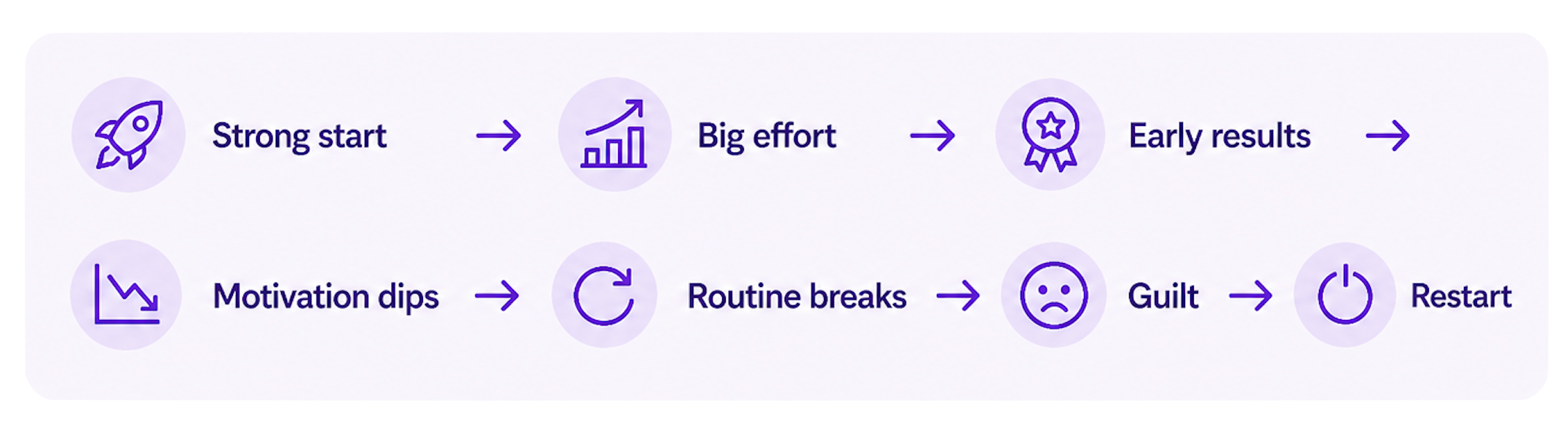
Results of relying on motivation alone
In reality, motivation is often the outcome of progress, rather than a starting point.

Motivation as an outcome
In real life, it is nearly impossible for motivation to stay high all the time, and how motivated you feel will naturally rise and fall over time. When motivation dips, this can create an illusion that you lack self-discipline and have failed - which is not the case! Because of this, motivation alone rarely leads to long-term success. In this article, we’ll break down what actually drives long-term change and how to create habits and systems which help you stay consistent, even when you don’t feel inspired.
Why motivation naturally rises and falls
In the early stages of putting new habits or changes in place, motivation often feels high as new goals are exciting and initial progress happens quickly. As progress starts to slow down or life becomes busier, motivation dips. This is very normal, and motivation is influenced by far more than willpower! Factors affecting motivation include:
- Stress and emotional load
- Sleep quality
- Work and family pressures
- Illness or pain
- Hormonal shifts
- Mental health
- Your environment
- Whether results feel visible
Expecting motivation to stay high indefinitely is unrealistic. Instead of thinking ‘How do I stay motivated?’, a more helpful question is ‘How do I make this change doable even when I’m not feeling motivated?’
What works better than motivation?
When motivation dips, big goals may start to feel overwhelming and unachievable. It can be helpful to think about small, feasible steps that feel doable and realistic right now. In practical terms, this could look like: going on a walk, having a balanced breakfast or having an extra glass of water a day. Instead of only focusing on results, adding value to small wins can help strengthen self-trust, reduce all-or-nothing thinking and create repeatable success.
Picking an action that feels doable and is realistic means that you are relying less on motivation to be consistent, as those small changes can hopefully fit your lifestyle.
- As well as focusing on the small wins, here are some more practical ways to help create consistent change:
- Create a routine that you can repeat or return to after a break in routine. This could include a particular meal structure or scheduled movement
- Track progress beyond the scales
- Reach out for support
- Practice self-compassion
Key messages
- In bringing about long-term change, motivation is often a result of actions rather than a starting point.
- Motivation rises and falls over time - this is natural, and a dip in motivation does not mean failure.
- Relying on motivation alone rarely leads to long-term success. When you are not feeling so inspired, having practical systems in place to fall back on is an effective and realistic strategy.
What our clinical experts say
Motivation is something that naturally rises and falls. At Genwell, we focus on building sustainable habits and strong support systems so you don’t have to rely on motivation alone. Through regular check-ins, personalised coaching and medical guidance, we help people feel supported even when motivation dips.
Bogomila Tosheva
Genwell reflections
At Genwell, we work by building supporting strategies, starting with something that doesn’t require a lot of effort, but instead, feels doable and realistic. Over time, celebrating these small wins compounds and change starts to feel more sustainable and doable. Our goal is to support you throughout your journey to build consistent habits over time,e which will enable you to achieve your health goals.