


Why does weight gain really happen?
Body weight has implications on a person’s life; their wellbeing and function, however, healthcare today understands that having overweight or obesity is a medical disease and can have further implications on health. Lots of us have heard about other long-term health problems, such as high blood pressure and diabetes, so how does obesity compare? The most recent data estimates that approximately 66% of adults in the UK are overweight or obese, compared to around 25% of the population experiencing high blood pressure (hypertension) and 8% suffering from Type 2 diabetes. With two-thirds of the UK population experiencing problems with excess weight, there are more and more studies being carried out on the reasons for weight gain, and emerging evidence shows that these reasons are far more complex than we ever thought before. With weight being so integral to a person’s physical and mental health, it’s time for a rethink about how we consider weight gain and obesity.
What is obesity? How is obesity measured?
The words ‘overweight’ and ‘obese’ are used to indicate a person who has a high body weight for their height and are technical terms used in healthcare settings to characterise a person’s weight.
BMI (Body Mass Index) gives a weight range according to a person’s height and is a single value that can be used to categorise a weight as healthy, overweight or obese. BMI measurements are well established in healthcare and are the most common method used to define obesity. As such, BMI is often used to create cut-off values for treatments; however, it is a crude figure and cannot account for age, sex or muscular build and does not consider the overall health or medical background of the individual. Some guidelines give adjusted BMI values to be used in certain ethnic backgrounds due to the difference in cardiovascular and metabolic risk factors and the typical fat distribution patterns seen in these populations.
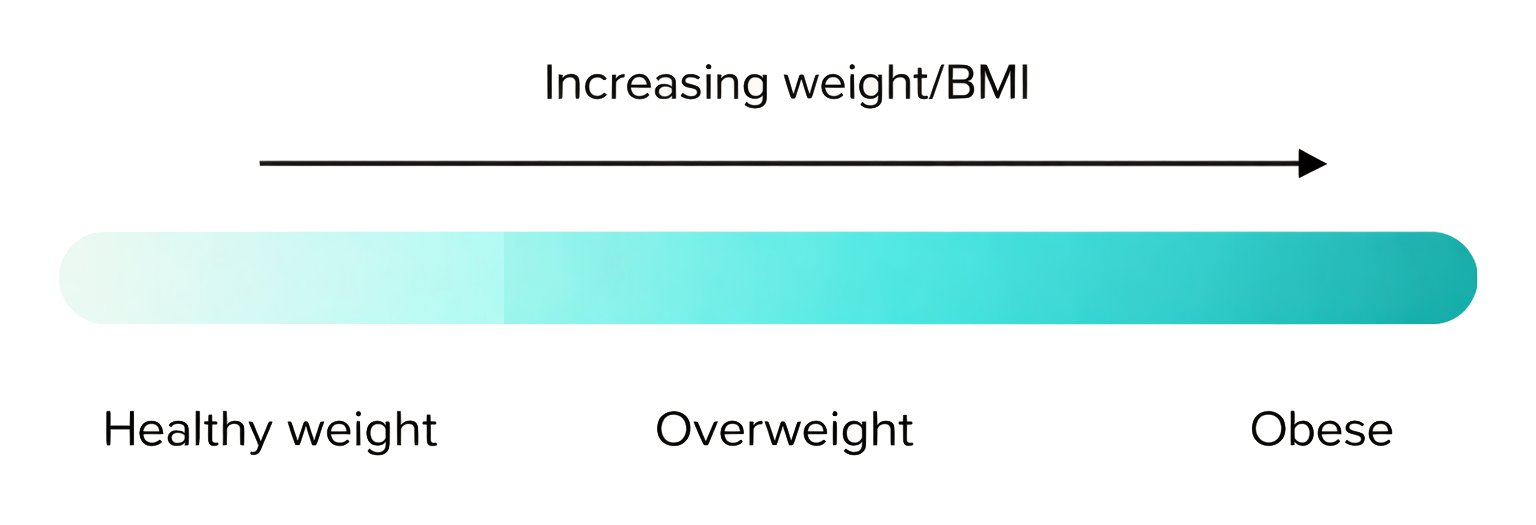
Scale demonstrating healthy wight BMI
To explore beyond the limitations of a single BMI measurement, more recent research suggests that obesity should be defined as “A multifactorial, chronic, relapsing, non-communicable disease marked by an abnormal and/or excessive accumulation of body fat that presents a risk to health.”In more straightforward terms, obesity is the long-term build-up of excess body fat, which has negative consequences on overall health.
Alongside BMI, other measurements such as waist circumference, waist-height ratio and imaging such as MRI or DEXA scans can give a more in-depth picture of fat excess, as well as fat distribution, which is also significant when considering risks to health.

Supported patient during consultation
Whilst BMI is often used to create strict cut-off criteria for classification and treatment eligibility, a more nuanced approach using additional measurements and looking at a person’s overall health and medical history can ensure that more people gain access to the right treatment and support they need to improve their health.
Why does body weight matter so much?
Obesity can have an impact on a person’s wellbeing and happiness; it can affect your own self-esteem and even how you are treated by others. But living with obesity also has a significant effect on the way your brain and body work: your own physiology and metabolism change when there is excess fat tissue over a long period of time. In terms of ‘risk to health’, people who are overweight or people with obesity are at an increased risk of developing a number of health conditions affecting almost every organ system in the body. Obesity is linked to heart disease and heart failure, cognitive function (such as learning and memory), liver dysfunction, kidney and bladder problems (including urinary incontinence), breathing difficulties, issues with reproductive health (in both men and women), joint pains, chronic swelling, and even some forms of cancer. As well as being associated with numerous medical conditions, obesity is often linked with poor mental health and self-esteem, as well as general day-to-day limitations and restrictions on activities.
Why does obesity happen?
So obesity is common and poses significant difficulties to individuals and society, but why does it happen? Why do we gain weight? If we take the popular phrase ‘Eat less, move more’ literally, it implies that obesity is caused by simply eating more and moving less. In reality, the answer to what causes obesity is far more complex than this; a person’s weight at any time is impacted by their psychology, behaviours, environment and genetics throughout their whole life! Let’s look at this in a little more detail.
The Biology
Appetite and satiety (the feeling of ‘fullness’) are controlled by a number of systems in the body which interact with each other. The brain, digestive system and fat tissue itself (yes, really!) all play a vital role in communicating with each other via a number of signalling molecules collectively known as ‘hormones’. Activation of these communication systems eventually goes on to modify our behaviours, for example, they may prompt us to seek out food, eat more, or stop eating. One of these hormones is known as Glucagon Like Peptide-1 (or GLP-1) and is released from the gut to signal that you have eaten enough. This leads to a reduction in appetite and an increase in the feeling of ‘fullness’ and satisfaction from eating. Fat tissue is an active substance, much like other internal organs or muscle tissue and is a major player in metabolism and these signalling pathways. Fat cells are crucial in storing energy and regulating systems associated with appetite and inflammation, and this is where fat distribution comes into play. ‘Subcutaneous fat’ (fat underneath the skin) has a different risk profile from what is known as ‘visceral fat’ (fat that is stored around the internal organs), which is more active and more associated with further medical problems. For example, a person with more fat around their abdomen is at a higher risk of developing further obesity-related health problems than a person with excess fat distributed more around the hips and legs. Fat cells stored around internal organs are particularly active and, when present in excess, can contribute to a rise in the overall levels of inflammation and insulin resistance to the extent that this causes disease in other body systems.
All of these signalling pathways do not operate in isolation - in fact, they can be influenced by everything else happening in your body, from your gut microbiome to the quality and quantity of sleep that you get every night. Certain medications and other medical conditions can also have a major impact on your body’s ability to regulate appetite and eating. These additional factors are significant; they are commonly linked to the development of obesity and, as such, are important to consider in weight loss.
Beyond eating for the sake of calorie intake and survival, human brains have evolved to associate food with connection and safety; food is powerful in bringing people together. This essentially explains why food has formed a massive part of different cultures around the world, and why eating is more than sustaining our physical bodies: it plays a major role in how we form relationships with the people around us and build communities. This more ‘emotional’ signalling associated with the human brain and eating (often referred to in research as the ‘mesolimbic system’) can be triggered by seeing, smelling or talking about pleasurable food. Dysregulation of this pathway can occur through inherited genetic factors or simply overstimulation through a continuous bombardment of advertising and media that we so often see in modern cultures. This dysregulation can result in something commonly referred to as ‘food noise’ and leads to chronic overeating.

Positive discussion of healthy food choices
Genetics also play a significant role in a person’s weight. A person’s genes can influence the ways that their body regulates signalling for appetite and satiety. It can also determine the extent to which these systems are influenced by the surrounding environment. i.e., triggers for overeating or stimulation of appetite can vary between individuals. It is estimated that there are over 1,000 genes involved in regulating body weight and that genetics could contribute 40-70% of the factors leading to an individual becoming obese within their life.
Society
The biology and physiology of weight gain are complex but have not changed much in recent human history. However, research shows that there has been a rapid boom in obesity over the last 30 years, and this can be linked to a number of changes within our environment. To use the increasingly popular phrase, our society has become ‘obesogenic.'
Socioeconomic status has long been linked with obesity, with those living in more deprived areas showing markedly increased rates of adults and children with obesity. Navigating the ever increasing cost of living often leads to choices of cheaper and more calorie-dense foods based on availability and accessibility, and we know from studies that having easier access to unhealthy foods increases the chances of developing obesity.
The change from active to sedentary jobs and lifestyles is another important factor at play. In addition to excess weight, studies show that lack of physical activity is linked with reduced muscle mass, bone density and physical independence, particularly in older adults, which only contributes to the vicious cycle of harmful weight gain. As well as the change from active to desk-based work, most of us are busier and doing more than ever. People have less time for preparing and cooking food, and can often develop a higher reliance on convenience and less healthy choices. This realistically happens to all of us from time to time, but over an extended period, these seemingly small choices have a big impact on our health.

Person sat at desk highlighting sedentary work
There is a certain stigma associated with being overweight. In some societies, particularly those that have experienced long-term food scarcity, obesity is viewed in a positive light as a sign of health and strength. However, many western cultures (incorrectly) associate obesity with gluttony, laziness and ‘poor self-control’ to the extent that great importance is placed on being slim to gain social acceptance. Unlike many other medical conditions, obesity is apparent from someone’s appearance, often resulting in immediate presumptions and judgment. This creates a massive negative stigma and discrimination around those who are overweight or suffer from obesity, and only adds more to the complexity of navigating the causes of unhealthy weight gain and subsequently addressing weight loss.
With all of these factors at play, it would be reasonable to consider, ‘Why aren’t even more people living with obesity?’ In reality, each individual has a unique set of circumstances surrounding their genetics and environment, and it is the combination of these that results in an individual developing obesity. Genetics provides the fuel, but a person’s behaviours and environment are what lights the fire.
Key messages
We are learning more and more that body weight is established through complex mechanisms which regulate our appetites, behaviours and health. Being overweight or obese is more than a characteristic of appearance and is classed as a long-term health condition.
- Overweight and obesity occur when there is excess fat tissue present
- Over time, being overweight or obese has negative effects on health
- Whilst BMI is commonly used, factors like fat distribution, other disease risk factors and overall health are important to consider too
- Behaviours related to weight gain are influenced by our genetics, psychology and environment
- Understanding what causes weight gain can help you both lose weight and achieve health goals and long-lasting wellbeing
Disclaimer: This article relates to adults and is for general information only and does not replace personalised medical advice. If you’re considering treatment, please contact our care team.