Welcome
Why weight matters for your health, the biology behind why it's hard to lose, and a different, kinder approach.
Why weight matters
Discussions about weight can feel very personal and are often avoided, but from a health perspective, body weight is an important piece of the wider health picture — particularly when it relates to metabolic health.
Carrying excess weight, especially around the middle as visceral fat, can increase insulin resistance, inflammation, and cardiovascular disease. This in turn can lead to conditions such as type 2 diabetes, fatty liver disease and certain cancers.
Even modest weight loss can lead to meaningful improvements in:
- Blood sugar control
- Cholesterol
- Blood pressure
- Overall metabolic function
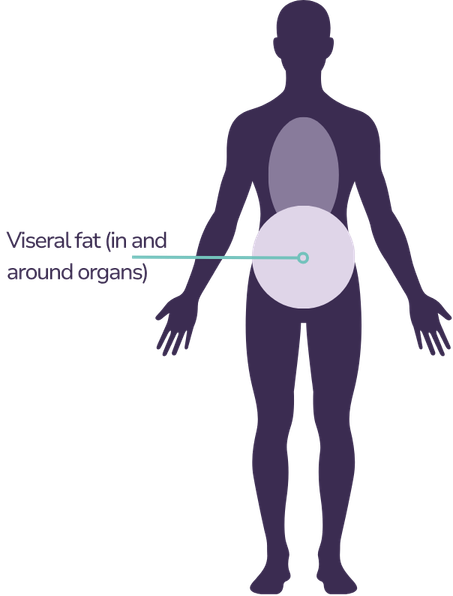
Excess weight and poor metabolic health can even make you feel unwell day-to-day by causing fatigue, brain fog, poor sleep, low mood, and increased hunger or cravings.
Addressing weight in a structured, supportive way is therefore not simply about being slimmer, but about improving how your body functions and how you feel.
It isn't because you're lacking discipline
If you're reading this, there's a good chance you've already tried to lose weight many times.
You may have followed structured diets, eaten less, exercised more, and fully committed — only to find the results were transient, inconsistent, or difficult to maintain. Over time this so often leads to frustration, self-doubt, and the quiet but persistent belief that perhaps the problem lies with you. We're here to tell you: it doesn't.
- Eaten less?
- Followed diets?
- Exercised more?
- Fully commited?
Weight gain and difficulty losing weight is not simply a failure of willpower
Overweight and obesity occur as a result of complex biological systems working to protect you, alongside the influence of your environment, genetics, hormones, and learned patterns around food and behaviour.
This is why they need to be understood as chronic medical conditions, requiring long-term solutions rather than short-term, one-and-done fixes.
Understanding the biology
Weight regulation is not a passive process; it is tightly controlled by your brain and body. A sophisticated network of hormones sends signals to regulate hunger and fullness, fat storage, energy conversion and blood sugar levels.
Your body interprets weight loss as a potential threat and works in opposition. It intensifies focus on food and energy storage, increasing hunger signals, reducing the sensation of fullness, and slowing your metabolic rate.
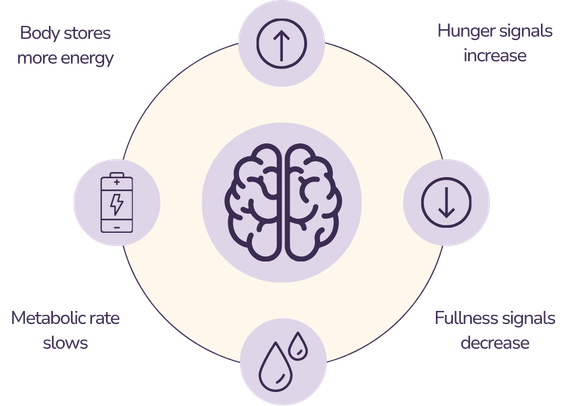
The net result is a weight-loss plateau, often followed by weight regain. This is not a flaw; it is a survival mechanism and forms the basis of the body weight 'set point' theory.
Body weight set point theory
Why weight loss isn’t just willpower
This refers to the range of body weight that your body naturally tries to maintain.
After a temporary period of indulgence, your body can actually help to get you back to your body set point by burning more fuel and reducing appetite. However, when weight loss has occurred, the body adapts in an effort to regain that weight by increasing hunger signals and reducing energy expenditure to bring you back.
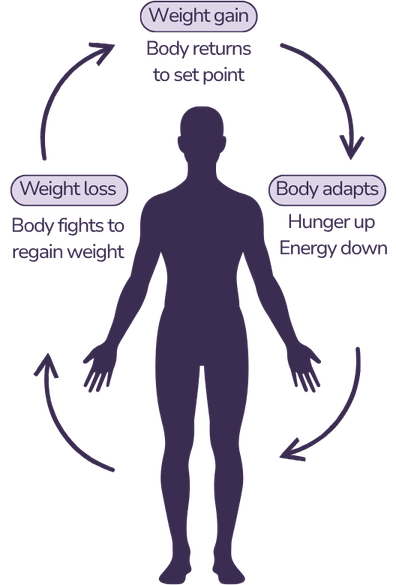
This is why weight loss can feel relatively achievable initially, but increasingly difficult over time, and why maintaining weight loss is often the greatest challenge of all. It is also why repeated cycles of dieting can make the process harder, not easier.
For many people, especially in midlife, these biological drivers are additionally influenced by:
- Hormonal changes
- Insulin resistance
- Chronic stress
- Poor sleep
- Previous cycles of dieting
The result is a system that is primed to resist weight loss, regardless of how motivated or disciplined you are or whether you continue to implement the changes you have worked so hard to put in place.
Why past attempts didn’t work
Many traditional weight loss approaches focus on restriction, eating less and moving more, whilst depending on motivation and discipline.
While these strategies can produce short-term results, they fail to address the underlying biological mechanisms.
This is not a reflection of a lack of effort. In fact, most people in this position show significant persistence in maintaining their weight loss approaches and strong resilience.
The issue is not effort
The problem is not that you haven't tried hard enough — it's that you've been working against your biology, rather than with it. Needing medical support for weight management is no different from requiring treatment for any other chronic condition.
The emotional impact
It is important to acknowledge the emotional impact of this experience.
Many people carry shame about struggling to lose weight, or guilt around not making the ‘right’ food choices. They might feel a sense of failure after repeated attempts and anxiety about starting again. These feelings are entirely understandable, but they are often based on a misunderstanding of how weight regulation works.
Needing medical support for weight management is no different from requiring treatment for any other chronic condition. We would not expect someone with asthma to ‘breathe harder’ or someone with depression just to ‘think more positively’. Weight regulation is biologically controlled and deserves the same level of understanding and appropriate treatment.
A different approach
This guide is not about imposing another rigid plan or expecting perfection. It is about helping you understand your body and introducing tools that work with your biology to support sustainable, long-term change.
For some people, this includes the use of GLP-1 medications.
As you move forward, the goal is to shift towards:
- Understanding rather than judgement
- Structure rather than restriction
- Support rather than isolation
- Progress rather than perfection
This is a fundamentally different approach and, for many people, it is the first time weight loss begins to feel both achievable and sustainable.
You have not failed. You have simply not yet had the right tools.

You have not failed — you simply haven't had the right tools
Genwell pairs clinical support with habits that work with your biology. See if it's right for you.
Check my eligibilityGet the PDF
Prefer a copy to keep or share with your GP? We'll email it to you as a PDF