Where GLP-1s fit in
What GLP-1 medications are, how they work, what they can't do, and why they're a tool — not a shortcut.
Understanding how our bodies regulate weight and how our traditional view of weight loss has been flawed are important first principles. The next step is to understand where GLP-1 medications fit within the picture and how they can support, rather than replace, a more sustainable approach.
What are GLP-1 medications?
GLP-1 medications were developed in the early 2000s for the treatment of type 2 diabetes, with the first drug approved in 2005. Since then, their role has expanded significantly as they are now additionally used in the management of overweight and obesity.
GLP-1 (Glucagon-Like Peptide-1) and GIP (Glucose-dependent Insulinotropic Polypeptide are naturally occurring hormones t released from the gut in response to food and play a role in how our bodies process nutrients.
GLP-1 medications mimic these effects. Semaglutide (Wegovy), mimics GLP-1 whilst tirzapetide (Mounjaro) has effects on both GLP-1 and GIP, and is known as a dual agonist.
How do they work?
GLP-1 medications act on several key systems in the body and have the following effects:
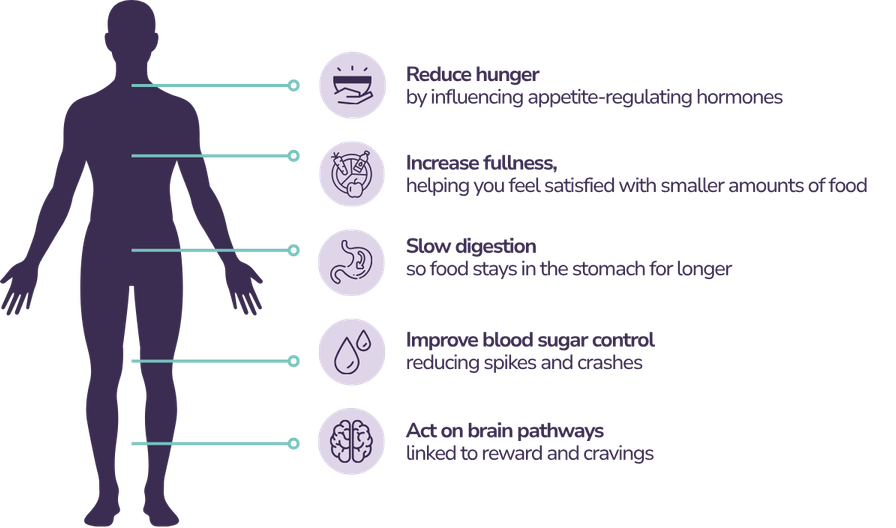
Combined together, these effects help reduce the ‘food noise’ and create the space to build habits more easily – this makes weight loss more achievable, whilst improving metabolic health markers such as blood sugar and cholesterol. For many people, this is the first time that weight loss doesn’t feel like a constant struggle.
What GLP-1s can't do
They can't replace the need for balanced nutrition. In fact, they can put people at risk of malnutrition if the dose is too high and they're eating insufficient nutrients due to appetite suppression.
Rapid weight loss from any cause can lead to muscle and bone loss too. Aim for high-quality weight loss that prioritises muscle and bone preservation, supported by sufficient protein and regular strengthening exercise.
GLP-1s don't address underlying habits or poor relationships with food by themselves.
Without working on these areas, medication will only ever be a short-term fix. You can’t guarantee long-term weight maintenance after stopping GLP-1s. However, if nothing else changes, the return of hunger, without established habits or tools to manage it, means weight is likely to increase. This weight will be in the form of fat and as muscle and bone mass, which may have reduced – and this deteriorates body composition further, increasing long-term risk of falls, and negatively impacting metabolic health.
This is why GLP-1s should be viewed as a really useful tool but not a replacement for a structured approach.
Are they a shortcut or a sign of failure?
The short answer is no.
Using a GLP-1 medication is not about taking the 'easy way out'. It's about using a clinically supported tool to address biological processes that are otherwise difficult to influence. Just as we use medication to support other chronic conditions, it's appropriate to use medical support in weight management when needed.
A balanced approach
GLP-1 medications can be highly effective, but they are not the answer alone.
The goal is not simply to lose weight by taking medication. The goal is to use it as a supportive tool — to create the conditions to build new habits more easily and lay the foundations for lasting change.
- Use GLP-1 as a supportive tool
- Build new habits
- Create foundations for lasting change
Small changes. Real support. Lasting change. You're not alone — our team is here to support you every step of the way.

See if GLP-1 treatment is right for you
A short eligibility check tells you whether Genwell can help — with clinical support at every step.
Check my eligibilityGet the PDF
Prefer a copy to keep or share with your GP? We'll email it to you as a PDF